For most cattle producers, the routine "check" has become one of the most expensive habits on the farm. Fuel Costs Are Quietly Draining Cattle Operations. Here's How GPS Ear Tags Stop the Bleed
Across cattle operations, one cost keeps climbing and rarely gets questioned: the fuel burned driving the property to check the herd. Week after week, that loop consumes diesel to confirm what is usually fine, and with fuel prices volatile, it has become one of the least predictable expenses in the business. GPS ear tags turn that speculative drive into a targeted one.
It starts the same way every morning. You grab the keys, fire up the ute, and head out to check the herd. By lunch, you've covered the fence lines, visited every dam, and confirmed that as usual, everything is fine. That's a full morning gone. A tank of fuel burned. Labour hours spent on confirmation instead of production.
A check round rarely registers as a major expense, it's "just having a look." But gathering and checking the herd adds up fast. A daily round of around 200 miles (US) or 200 km (AU) in a pickup burns a serious amount of fuel before a single animal has been moved, and that's before servicing, tyres and depreciation, which often cost two to three times the fuel itself.
The deeper problem is what that fuel buys. Most days, it confirms nothing changed. You pay to find out you didn't need to drive. And because fuel prices swing with global markets, it's a line item you can't budget with any confidence.
The average producer spends up to 3 hours a day on physically mustering and checking cattle, riding paddocks, inspecting fence lines and running water points to confirm troughs are full and animals are present.
Run the numbers and the cost is staggering. The table below shows the fuel and labour a producer can reclaim by replacing the manual herd check with mOOvement. Figures are illustrative and based on the assumptions listed underneath.
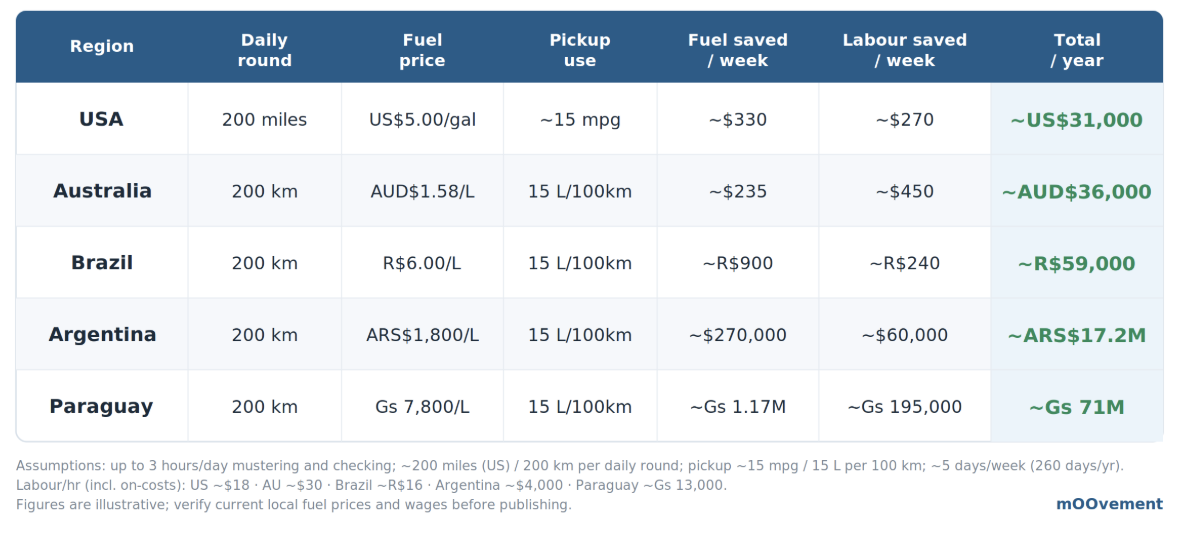
That's $30,000+ a year that could go to genetics, fencing or pasture improvement instead of driving past paddocks you already know are fine.
That's not a small number. It's real money that could be reinvested directly into your property.
Right now, that money is being burned. With mOOvement, you decide where it goes.
The mOOvement system replaces the physical check with a simple glance at your phone. GPS + BLE ear tags provide:
And the "tag-along" model keeps it affordable: one GPS tag scouts for three nearby BLE tags, so you cover four animals for the connectivity cost of one. You can also check water points remotely, cutting another fuel-heavy chore, the "water run."
Affordability has been a barrier to broader adoption of GPS cattle tracking, but mOOvement solves this with its tag-along architecture. One GPS ear tag scouts location data for three companion BLE ear tags, enabling you to track four animals for the connectivity cost of one.
Bundles start at $2,618 for 25 tags, including the gateway antenna, scanner, applicator, and a full year of connectivity subscription. Larger operations can scale to 500 tags or more without incurring prohibitive per‑head costs.
The payoff isn't only the diesel you don't burn; it's the confidence to leave the ute parked. One long-time user captured the shift: "Before mOOvement I used to travel at least three times a week to check on my stock. Now I have more time to focus on growing my business, and save $580 a week.", Sean O'Brien, Cowell, South Australia. Across five continents and 23 countries, the pattern repeats: fewer speculative kilometres, lower running costs and steadier budgets.
With fuel costs unlikely to settle any time soon, the cheapest litre is the one you never burn. See how the system works on the mOOvement GPS ear tags page, and turn your fuel spend from a hunch into a decision.

